


Dead Mice Tell No Tales, or, the Supernatural Cat
July 12, 2026 • No Comments
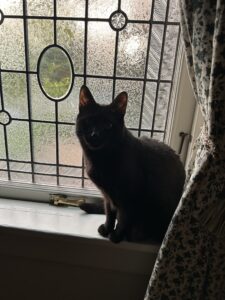 I recently browsed through a book that celebrated the relationship between felines and literature. Many famous writers enjoyed whiskered companions—Hemingway, for instance—and I personally agree that furry company makes the long hours of word-wrangling more pleasant.
Likewise, cats feature in the history of painting and music. Perhaps it is because of their sleek beauty and unmatched grace. Or perhaps it is because they are touched by a sense of the uncanny. The magical. I would go so far as to say supernatural, for how else can a tiny kitten barf hairballs with the prowess of a demon from The Exorcist?
Cats are the customary companion to witches, mostly because witches have a warm hearth, interesting leftovers (yummy eye of newt, anyone?), and the kind of free-wheeling lifestyle that doesn’t include vets or rules about scratching furniture. Witches aren’t bothered by a fey sprite of a pussycat prancing on the rooftop and yowling with spine-shuddering volume at 3:00 am. Or, maybe they are but the cat doesn’t care.
The feline’s reputation as a familiar comes from their ability to mediate between the realms of the living and the dead. This can be seen in the most domesticated of the species, who stare at empty corners with luminous, lamp-like eyes. They see what we don’t. They also walk between worlds, disappearing and reappearing at random moments, typically where they’re not supposed to be. They judge us and the ghosts equally.
The same applies to those who become companions to the undead. Most assume vampires do not keep pets, but a feline’s predatory and nocturnal nature makes them good companions. Besides, a creature with nine lives pairs better with an immortal, who appreciates the more enduring bond.
Cats are indifferent to the histrionic highs and lows of the vampire lifestyle. Their disgust is unmatched when the vampire (like a child licking the icing off a cupcake) takes the juicy bits of its prey and leaves the rest. Cats enjoy the silk and velvet lining of the coffins—just another box to sit in—while they deplore the undeads’ lack of a warm lap. No sense of supernatural dread ever ruffles their fur. Despising all two-legged pretenders, cats consider themselves the best hunter in the room and will occasionally bring their vampire a mouse treat to prove it.
Felines are nowhere as enthusiastic about shifters. Any creature who would voluntarily assume human shape is suspect at best. Werewolves are far better off sharing a bowl of kibble with their doggy companions while watching the game. As for selkies, merfolk, and such watery individuals, no cat will deign to consider that much damp.
Rapping with the Dead
February 7, 2021 • No Comments
 Who doesn’t love a good coincidence, especially when it involves ghosts?
 Who doesn’t love a good coincidence, especially when it involves ghosts?
Recently I was blathering with a friend about contacting the dead (as one does while folding laundry). I’m stocking up on ideas for a new story, and it was an unplanned but fruitful topic. Literally minutes later, I got an email for a virtual event.
Cue Weird Homes Tour and Atlas Obscura featuring Brandon Hodge. Hodge owns an Austin, Texas residence stuffed with Spiritualism-related objects. For one very fun hour, Hodge took viewers through his collection of antique planchettes, Ouija boards, and other paraphernalia.
It was like a gift-wrapped package falling through the monitor and into my lap. Spiritualism fascinates me, and Hodge’s enthusiasm and fab website are an ideal introduction to the subject.
A Victorian Obsession
The Spiritualist movement gained traction in the mid-1800s. It gave us mediums, automatic writing, ectoplasm, spirit photography, and table-rapping.

Essentially, it’s summoning the dead for a chat. Believers included the rich and famous, from Lucy Maud Montgomery to Arthur Conan Doyle.
For a buttoned-up society focused on industry, cataloguing, and petticoats for the piano legs, it’s interesting how Victorians embraced the paranormal. Their enthusiasm can be seen by the many, many periodicals dedicated to the topic, such as The British Spiritual Telegraph.
Celebrity
Mediums achieved a kind of celebrity, like the Fox sisters in America. Some grew rich. Others were ingloriously debunked for coughing up gauze
“ectoplasm” or manipulating the seance props with wires.
The majority of mediums were women. This was one place she could take center stage without question. And, since the bereaved were willing to pay, she could also make a good living.
Spiritualism carried on—unsurprisingly—through the disasters of WWI and the Spanish flu epidemic until fading in the 1930s.
Stories
I’ve used the highlights of Spiritualism before. In A Study in Ashes, Evelina and Tobias attend a séance. At the time, I’d wanted to delve more deeply into the subject, but that wasn’t part of Evelina’s story. She simply paved the way for more.
Now—thanks to a chance lockdown presentation—I’m anxious to do more research. After all, what’s more perfect than something that is Victorian, paranormal, and involves intriguing devices? I’m positive there is a role for a planchette or two in my Hellion House series.
Will-o-the-wisps
May 22, 2018 • No Comments
 We all know the past has a pull on us. We write about literal ghosts, but there are plenty of metaphorical ones as well. Some are even more powerful and/or frightening than a chain-rattling specter. These haunts are the echoes of past selves that—for good or ill—we’ve somehow left behind. Memories, emotions, past selves we’ve given up for a higher good or a harder road—nothing is ever truly gone when it’s a part of our soul. Sometimes that’s a relief, or an ache, or both.
Dreams delayed are the strangest of these shades. This weekend was full of open-air concerts and sunshine and the first flush of the festival season. I took time away from my desk to bask in the warmth and watch one of my favorite bands. As a creative, I had two loves—writing and music, and I had to make a choice between the two. I could only nurture one properly and still hold down a full-time job. I chose storytelling, in part because it was an easier fit with a workaday schedule, and I still believe it was the sensible choice. I can’t say that music is a road not taken, because I took that path as far as I could go at the time. I think of it as a road with a bridge temporary closed for maintenance. That doesn’t mean I don’t feel the ache every time the ghost of my musical soul stirs.
I’m not alone, of course. The demands we face as creative entrepreneurs aren’t easy, especially when responsibilities tie us to corporate jobs and all that reality entails. Creativity in that context is an extraordinary quest—one that takes us through feats of time-bending, identity-shifting, and fiscal sleight-of-hand. We transform in metaphorical phone booths, unleashing our true selves in the privacy of hidden spaces. We might not conquer literal armies, but we defend our kingdoms all the same. There are precious things inside us, and creatives fight to keep them alive.
We live in hope for eventual freedom, of a victory before it’s too late. Only then can we be whole again, returning all those lost ghosts to the hearth of our souls.
It’s a dream, but we have to believe it.