


Celery with Attitude
 ‘Tis the season of rhubarb. That means rhubarb pies, jams, crisps, and all kinds of baked goods until, for those of us that grow it, we’re tossing bagsful into the freezer because we can’t face one more mouth-puckering stalk.
Some call it celery with attitude. It is insanely resilient once established, barely needing humans to do more than turn the hose on it once in a while. Where entire settlements have vanished, patches of garden rhubarb have gone wild, providing archaeologists with reliable clues where to start looking for signs of forgotten habitations. More than one Gold Rush ghost town in the Pacific Northwest can be identified via a trail of the plants. When humanity ends, it will still be thrusting its plate-sized leaves into the apocalyptic light.
It’s been used for medicinal purposes since time immemorial, starting in China and traveling the Silk Road to eastern Europe, where it rapidly marched westward all the way to North America. The only limitation on its spread is that it likes cool winters, so it’s most prolific in the north. It is still used medicinally for digestive issues, essentially as a purgative (note: the leaves contain oxalic acid, which can be poisonous, so only the stalks are used). It also makes frequent appearances in “spring tonic” recipes as it’s one of the first fresh vegetables (yes, it’s a vegetable) to show up after the snow melts. It’s high in Vitamin K, C, and calcium.
Sometimes called the pie plant, it frequently co-stars in the kitchen with strawberries. I like it with ginger. In any event, rhubarb wasn’t regarded as a culinary option until the advent of the sugar trade in the eighteenth century, when there was sufficient sweetness available to balance out its acid personality.
Paradoxically, rhubarb is associated with the goddess of love, Venus, and her son Cupid, presumably because it’s a Valentine-y red. Or maybe the link is the sharp sting of arrows? In other folklore, it features in cleansing spells, for getting rid of whatever has outlived its usefulness. That, at least, makes sense to me. Rhubarb is all about the pleasant pucker that chases away any other lingering flavors.
Here is a recipe that makes the most of rhubarb’s tartness.
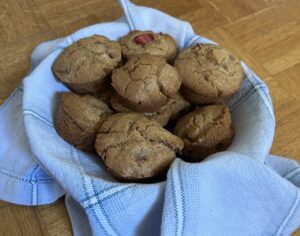
Strawberry Rhubarb Muffins
Yields 1 dozen
Sift dry ingredients:
2 cups of flour*
1 tsp baking powder
½ teaspoon baking soda
¼ teaspoon salt
½ cup of brown sugar (packed)
½ teaspoon cinnamon
*The type of flour is flexible. 1 for 1 gluten free, half white/half whole wheat, or spelt all work
Whisk together:
2 eggs
½ cup melted butter
½ cup kefir or buttermilk
Tablespoon lemon juice
Make a well in the center of the dry ingredients and pour in wet mixture. Mix lightly and fold in:
½ cup chopped strawberries
½ cup chopped rhubarb
Divide into greased muffin tins and bake for 20 minutes
Enjoy!