


Dead Mice Tell No Tales, or, the Supernatural Cat
July 12, 2026 • No Comments
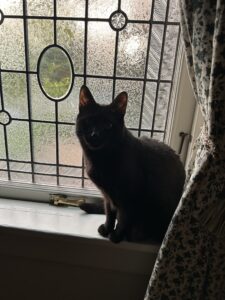 I recently browsed through a book that celebrated the relationship between felines and literature. Many famous writers enjoyed whiskered companions—Hemingway, for instance—and I personally agree that furry company makes the long hours of word-wrangling more pleasant.
Likewise, cats feature in the history of painting and music. Perhaps it is because of their sleek beauty and unmatched grace. Or perhaps it is because they are touched by a sense of the uncanny. The magical. I would go so far as to say supernatural, for how else can a tiny kitten barf hairballs with the prowess of a demon from The Exorcist?
Cats are the customary companion to witches, mostly because witches have a warm hearth, interesting leftovers (yummy eye of newt, anyone?), and the kind of free-wheeling lifestyle that doesn’t include vets or rules about scratching furniture. Witches aren’t bothered by a fey sprite of a pussycat prancing on the rooftop and yowling with spine-shuddering volume at 3:00 am. Or, maybe they are but the cat doesn’t care.
The feline’s reputation as a familiar comes from their ability to mediate between the realms of the living and the dead. This can be seen in the most domesticated of the species, who stare at empty corners with luminous, lamp-like eyes. They see what we don’t. They also walk between worlds, disappearing and reappearing at random moments, typically where they’re not supposed to be. They judge us and the ghosts equally.
The same applies to those who become companions to the undead. Most assume vampires do not keep pets, but a feline’s predatory and nocturnal nature makes them good companions. Besides, a creature with nine lives pairs better with an immortal, who appreciates the more enduring bond.
Cats are indifferent to the histrionic highs and lows of the vampire lifestyle. Their disgust is unmatched when the vampire (like a child licking the icing off a cupcake) takes the juicy bits of its prey and leaves the rest. Cats enjoy the silk and velvet lining of the coffins—just another box to sit in—while they deplore the undeads’ lack of a warm lap. No sense of supernatural dread ever ruffles their fur. Despising all two-legged pretenders, cats consider themselves the best hunter in the room and will occasionally bring their vampire a mouse treat to prove it.
Felines are nowhere as enthusiastic about shifters. Any creature who would voluntarily assume human shape is suspect at best. Werewolves are far better off sharing a bowl of kibble with their doggy companions while watching the game. As for selkies, merfolk, and such watery individuals, no cat will deign to consider that much damp.
Oh, the horror of it all!
October 13, 2025 • No Comments
 I’m writing this in October, a few weeks before the heart of spooky season. Already the mercantile machine is pushing Halloween treats from candy corn to Children of the Corn. I wanted to write Children of the Candy Corn, but someone else got there first.
In any event, it has me pondering the function of horror in art. Yes, I know finer minds than mine have written entire books on this, but I’m thinking from a personal perspective. There are entire subgenres that don’t ping on my personal radar. Chopping people to bits while they’re still alive doesn’t push my entertainment buttons. Nor does ambulatory decomposition. I used to love a good plague story until I lived through one. In other words, I’m picky as a consumer and a creator. I want my horror just so, and I want it to pull its creative weight whenever it’s pressed into service.
This is why, in my opinion, so much horror falls flat. The threat (demon, evil house, weird neighbors, giant bug, fungus as a dramatic character, and on and on) is relatively interchangeable. Whether or not it is verbal and/or has a backstory (the bug was unloved as a grub), it wants to kill/dominate and not much else. It scares us a little or a lot, but in the end we just want it to stop munching the cast. We don’t care about its feelings.
What I want in a good monster is the killing machine, but with an artistic and emotional purpose.
Take vampires, that old horror standby. They are not, generally speaking, vegans. They are apex predators, and we are lunch. This is fine. Like Chekov’s gun, one should not introduce a loaded vampire to the proceedings unless one intends to use it. But it needs to do more than be broody and lethal.
Enter Dracula. For the era in which he was birthed upon the page, he is a sophisticated monster. He definitely bites, has a well-defined plan, and is a master manipulator. He represents a halfway point between stock villain and real personality. We get glimpses of his history, but admittedly the reader receives a limited account of his feelings and motivations as compared to the other characters. Our response to Dracula is largely filtered through their experience. How they respond to him and uphold their own self-identities is what really makes him an interesting villain.
But what about paranormal romance vampires, such as in the Dark Forgotten series? Modern readers need a well-rounded character for a romance to engage, so authors have work to do. When I create a vampire protagonist, I try to make that individual sympathetic without diminishing their dangerous instincts. They have their own goals, wants, and desires, but they are still wolves, not golden retrievers. A “safe” vampire, in my opinion, negates the thing that makes them compelling.
And what is that secret sauce? As with Dracula, the struggle between human and non-human impulses is what makes the vampiness of the vampire fascinating. More often than not in paranormal romance, that struggle is taking place within the vampire character. How can they reconcile their instincts and their heart? It’s what makes them mad, bad, and dangerous to know—and oh, such fascinating forbidden fruit.
The same can be applied to any kind of monster. For werewolves, please see The Company of Wolves, a brutally beautiful 1984 film based on a work by Angela Carter. It takes the schoolroom right out of Red Riding Hood and has a lot to say about our animal nature.
The struggle to remain what we believe ourselves to be is the primary occupation of the kind of horror I prefer—what makes us human, or not, and how that sometimes means crossing lines we didn’t even know were there. Good art challenges our assumptions and makes us think. Tearing away our carefully-constructed self-image is uncomfortable, and good horror does that gently, insidiously, or with a force of eleven out of ten.
It’s a good kind of awful.