


Pretentious Mappage
 Novelists frequently ask themselves where their book is going. Several answers frequently spring to mind:
- Splat against the wall
- Into the recycle bin
- It has packed its bags because you, its creator, are unspeakably lame and it has, y’know, dignity to consider
That said, the question frequently refers to either unresolved plot issues (my sympathies) or a question of geography. Literally, where are your characters going? Left or right? Do they go by cab or can they go on foot? Is that the same as what they did a hundred pages ago, or has the distance inexplicably increased due to narrative requirements? (Bad author! No cookie!)
Back in the day, every self-respecting fantasy novel came with a map. Back then, such paperbacks were meaty specimens, difficult to open flat, and half the landscape disappeared into the spine. Nonetheless, it was possible to visualize where our trusty band of misfit companions blundered their way through Perilous Landscape. Tracing my way between wizardry and danger led to much satisfying geekage. I imagined leading my army of unicorns/trusty knight/talking animals into the story and solving everything much better than the fool writing the book. So there.
The custom of including maps dwindled along with “cast of character” pages and glossaries. And, maybe reader tastes changed. I actually had an editor proclaim these appendices as “pretentious”, claiming that the average book buyer would be scared off by extras. Personally, I think cost might have played a role, too. Anyway, I’m happy to say that the era of independent publishing has brought many of these features back, and not just to impress and/or terrify the public.
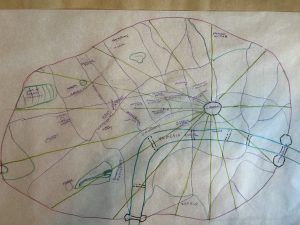
Even when not actually part of the finished product, maps help authors remain consistent over a series. This wasn’t such a consideration when writing The Baskerville Affair as that was based on 1880s London, and a good historical map and a few walking tours worked just fine. The Hellion House series is a different matter. The landscape is based on a version of London that departed wildly from history as we know it in about 1590 or so.
There are excellent artists and many software products that help with cartography, but there’s a lot of background work first. Even the best designer can’t chart something simply by reading my mind. Sadly, almost five books into a series is a bit late to start cataloguing all the places and references to how long it takes to get from A to B.
I started by drawing my own map. No, it’s not pretty, but I got the basics down—the wall, the mages’ gridline of silver to conduct the magic from the Citadel to the city defenses, major roads, the airfield, the cemetery, and important houses. I added some of the other spots, like the police station, that show up more than once. It’s enough of a start that I can seriously consider aesthetics. Maybe something nice to include in a future book? At the very least, maybe my characters will stop falling into the river when I give them bad directions.