


A Witch’s Garden
May 24, 2025 • No Comments
 This is one of those topics that comes with caveats because, I am sure, a witch’s garden is whatever the witch wants it to be. Gardens are reflective of their caretaker’s personalities and therefore as unique as each individual and purpose. And, as with a witch’s cat, a witch’s garden (any garden, really) will have its own agenda.
The Basics
That said, there will be guiding principles. In traditional folklore, witches lived in an agrarian setting, either as part of a community or adjacent to it. It stands to reason that, whatever else the witch was up to, they most likely planted a kitchen garden: herbs, vegetables and, if they were fortunate, a few fruit trees. There were likely some pretty flowers to attract pollinators and ensure a fruitful harvest.
Does that sound disappointingly mundane? It shouldn’t. Just because plants are well-known to us, don’t assume they are without enchantment. Apples have long association with myth and magic—from Snow White to Avalon, they are the go-to item in the fairy tale produce aisle. Helen of Troy might have been the face that launched a thousand ships, but it was the prize of a golden apple that started it all.
Sadly, I’m short of heroic legends featuring kale.
Medicinal Gardens
It’s fairly well-established that historically witches tended to be older single women with opinions and, more notably, land and fortunes the male elders felt would be better off in other hands. Say, their hands. As part of the property transfer process, these troublesome females were accused of concocting poisons, curses, and spells. Noxious herbs were prominently featured.
A knowledge of healing herbs was part of any housewife’s toolkit. They would be grown or gathered in season and preserved for future uses. What those herbs were varied depending on local practice, but a few are easily identified. Eyebright, for instance, is easy to use for making an eyewash effective for seasonal allergies. Heart’s ease, also known as wild pansy, has been used since the Middle Ages for cardiovascular and autoimmune issues. These plants were used so widely they were named for their healing properties.
Danger Gardens
What can cure, can kill. Plants are at the front of this line. An easy example is digitalis, or foxglove. While it’s the basis of an effective medication, it features in dozens of mystery novels as the heart-attack-inducing herbal slipped into a victim’s tea. Similarly, the right kind of eucalyptus infused in honey is a great cough syrup. The wrong kind is only good for koala bears. Even common culinary herbs, like thyme, can have adverse health effects in the wrong doses.
This is the territory of the Hollywood witch’s garden. Or, in more of a real-life setting, the Alnwick Poison Garden. On the surface, it might look fairly ordinary—mandrake is highly poisonous, but is just another bushy green thing to the untrained eye. Whether a curse or a cure, who needs magic when botany can do the heavy lifting?
To understand how to prepare and deploy the garden residents is the practitioner’s true power. A well-tended plant is very willing to show just how capable it can be. It’s only sensible to be cautious and very, very polite to whatever witches, fairies, or other garden keepers are about.
Magic Gardens
While gardens can feed, cure, or kill us, is there room for a magical element that would set a witch’s garden apart? Yes, I’m sure there is. I’ve been to gardens that felt special in a way that’s impossible to describe. I was taught as a child to leave a corner of the garden wild for the nature spirits, so maybe that makes the difference. The best words I have for those gardens with a little extra is harmony. They’re functioning as an energetic whole instead of a collection of manicured parts.
The witches in my books don’t always have gardens like the Carvers in the Dark Forgotten series do—some do live in apartments—but they do have an understanding of the energies that guide the botanical world. Healing is about restoring nature’s design. Evil is disrupting it. Vampires are in some ways outside nature—they have stepped beyond the norm into a kind of suspended state.
What kind of gardens would vampires have? I found this post from the National Garden Bureau on goth gardens. I’m enchanted by the blenderized concoction of yogurt and moss that can be painted onto objects to encourage insta-mossy hardscaping.
DIY Historical Cosmetics: Queen of Hungary’s Water
April 26, 2021 • 3 Comments
 Queen of Hungary’s Water aka Hungary Water has been one of my favourite scents for as long as I’ve been wearing perfume. It’s herbal rather than sweet, with a clean, bright finish. Though no two blends are exactly the same, lemon and rosemary are usually the dominant notes. As I was making this up, the scent of the herbs was almost dizzying. It’s like a herb garden in a jar.
Some sources claim Queen of Hungary’s Water is the first alcohol-based perfume, or at least the first European one, and dates from the beginning of the fourteenth century. It’s also used as a skin tonic, the herbal ingredients effective against acne and eczema, among other issues. In addition, it can be used to bathe the temples to cure a headache. It is for external use only. Do not drink it or take it as a tincture.
Ingredients are important
There are a lot of different recipes for Hungary Water, but be careful. Beware of recipes that use lemon verbena as a main ingredient as the essential oil of that plant has been linked to sun sensitivity, which can increase the likelihood of sunburn. Lemon balm does not have the same problem.
Try to get organic herbs and essential oils if you can. Good quality dried herbs will store in a cool, dry place until it’s time to make another batch.
Recipe:
Layer the herbs in a wide mouth jar. A mason jar is ideal (bigger is better – the herbs swell once the liquid goes in).
2 tablespoons of lemon balm
2 tablespoons of lavender
2 tablespoons of calendula
2 tablespoons of rose petals
2 tablespoons of chamomile
1.5 tablespoons of comfrey
1 tablespoon of sage
1 tablespoon of rosemary
1 tablespoon of peppermint
1 tablespoon of elderflowers
12 drops of helichrysum oil
Top with chopped lemon peel (1/3 of a lemon rind, pith removed)
Cover the herbs with apple cider vinegar, witch hazel, or vodka. Allow for a couple inches of liquid above the herbs. Store for several weeks, shaking a couple of times a day.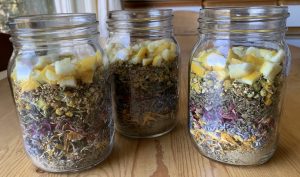
As this is my first time making this, I’ve done one each using the vinegar, witch hazel, and vodka to see which turns out best. Please see this blog for the results.
I based this recipe on several existing sources both in books and online, including this one, this one, and this one. I’ll adjust the ingredients as time goes on until I create my own preferred combination. For now, I’m sharing my experiment with you!
Post Script
Please note:
Yes, I am a writer of vampiric fiction, but before you get excited, dear reader, the Hungarian noble in question is not Elizabeth Bathory of “bathing in the blood of virgins” fame, nor does this post describe a bracing post-blood tonic or solution for that awful bathtub ring. I suggest a foaming cleanser with plenty of bleach for that.